
Inducción
-
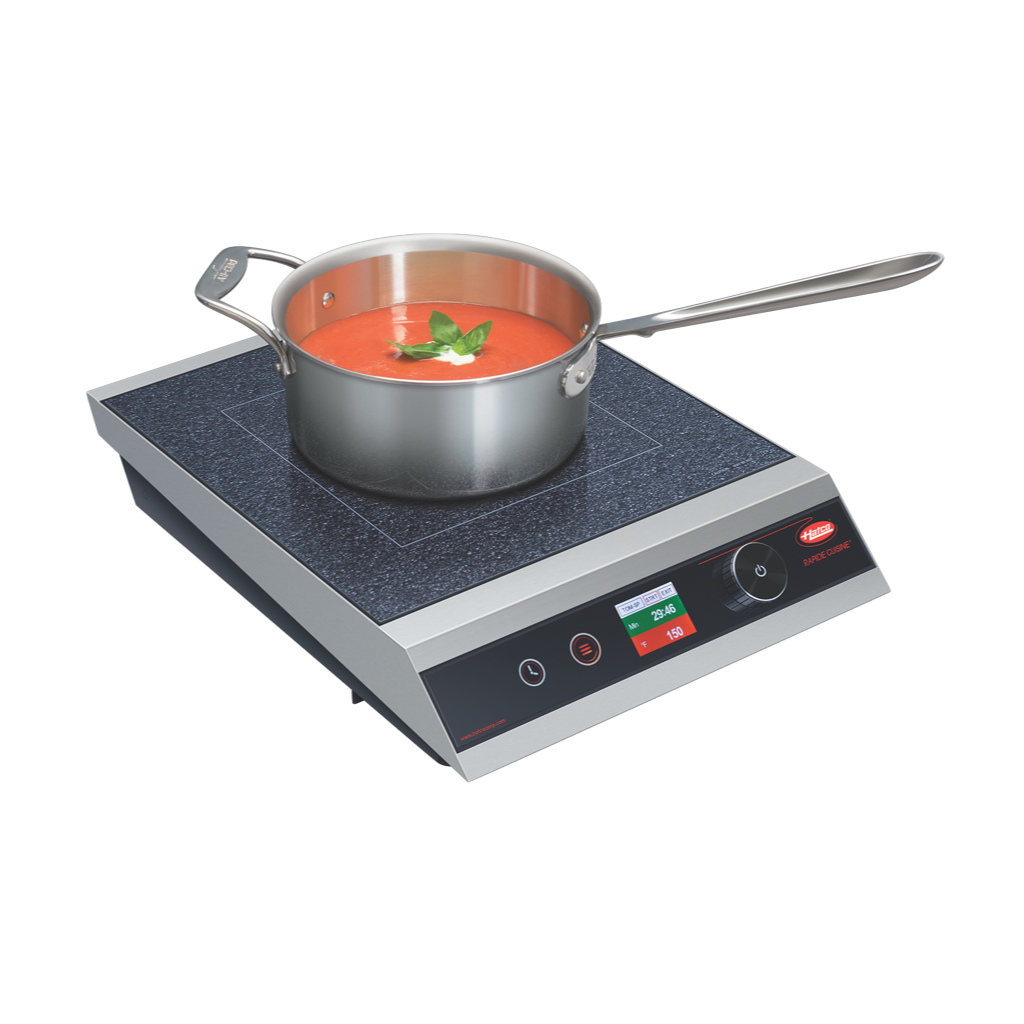
You can only use 80% of a circuit's rated capacity, so I can't buy an 1800W induction unit and use it on a 15A circuit in the USA.
The 80% "rule" (which is actually 125% of a breaker's rated capacity) applies to continuous maximum loads (like pumps and motors). Induction units are a non-continuous load, which is why an 1800W unit is supplied with a NEMA 5-15P molded plug, and can be used on a 15A circuit. Note this does not apply in Canada, where the rule is different. Many manufacturers (including Hatco) offer a 1440W version with a NEMA 5-15P plug in order to comply. Just to confuse things, California allows the use if two exempt pieces of equipment at up to 1500W each without an exhaust hood. Induction units are on the exempt list, hence the Canadian model is often used in California also in such applications.
-
What's the weight limit for the induction glass tops?
There really isn't a prescribed weight limit. You can stand on the ceramic glass and it will not break. The dimension of the top acts as a natural inhibitor for how much you can put down on them.
-
Those glass tops on the induction units don't look very strong. Are they really up to the task?
The tops have to pass a very stringent test called UL197. They have to withstand the impact from a 1.2-lb. (0.4 kg) steel ball from 21" (533 mm) and a 4-lb. (1.8 kg) pan dropped 10 times from 8" (203 mm). For cooktops - especially commercial ones - "ceramic glass" is better than tempered glass. They both pass the same drop tests, but tempered glass can bow at high temperatures (e.g. if a pan has been heating on the top for a long period).
-
Isn't induction dangerous, like X-rays - particularly if you have a pacemaker?
Induction cooktops have been out for 30+ years, while induction technology has been used in industrial applications for well over a century. There are no recorded cases of any injury (or harm done to a pacemaker user) in all of that time. The American Heart Association lists a number of everyday devices and appliances that should be avoided (including mobile phones). Induction cooktops are not listed among them. The wave is only about an inch deep above the surface of the cooktop, and is "fully captured" by the pan in place. Without a pan in place, the unit only "pings" looking for a pan, but does not fully energize. Even compatible small objects, such as spoons, are "ignored" as a safety measure.
-
Induction is a bit like microwaving isn't it? The food suffers and you don't get a good sear?
Induction cooktops heat the pan. Sure, they do this in a different way to gas or electric, but they still heat the pan - not the food. The food is in contact with the hot pan and is heated or cooked in entirely the normal way. Induction is generally faster than gas and heats the whole thickness of the bottom of the pan at the same time - not just from underneath. So, it's actually better for searing - there is no lag time, and recovery is almost instant. The heat is more evenly distributed, too.
-
Induction doesn't sound very powerful. I just went online and converted 1800W to BTUs. It came out at just 6100! Surely that's not enough to cook?
The "pure" conversion does not take relative efficiency differences into account. Gas burners are typically only 35-45% efficient (which is why commercial kitchens using gas are often so hot). Induction cooktops are anywhere from 80% to 95% (depending on how it's measured), but as a rule of thumb, an 1800W induction unit is the equivalent of 16,000 BTUs of gas.
-
I heard that you had to spend a lot of money on "special pans” for induction.
Sometimes the phrase “induction compatible” is used by pan manufacturers to command a premium. In truth, any magnetic pan will work. The higher the ferrous (iron) content, the better. Many cheap steel or cast iron pans perform really well. A great simple and cheap compatibility test is a fridge magnet - the stronger the attraction to the bottom of the pan, the better it will work in general. Easy! Many stainless steel pans are magnetic, while some aluminum pans are made with a steel (iron) core, sandwiched in the base, so that they will work on induction. This type of pan generally works very well – the steel inducts, while the aluminum conducts the heat up the sides. It's true though that copper and all aluminum pans will not work. There is an approach to using induction on non-compatible pans that will allow for it, but it's prohibitively expensive and puts a lot of stress on the internal components. There's a cheaper alternative, too - to put a disk of compatible material between the cook top and the pan, but this is an inelegant solution and defeats most of the benefits of using induction!